Dm guitar chord for beginners
Use only the thinnest four strings and keep the first finger relaxed.
Quick answer
Dm is a medium beginner guitar chord. Practice it by building the shape slowly, checking every string, and then using it in an easy song.
- Fingers: 3 fingers
- Course order: Day 4
- Tip: Use only the thinnest four strings and keep the first finger relaxed.
Why Dm buzzes, and how to fix it
Almost every buzz on Dm comes from one of three things: a fingertip landing flat instead of on its tip, a finger sitting too far back from the fret wire, or a neighbouring string being brushed by the underside of a finger. Play each string on its own, find the dead one, and fix only that finger. Do not re-grip the whole chord.
The drill that actually works
Getting into Dm is only half of it — the real skill is leaving and returning. Build the shape, strum once, then lift your whole hand a few centimetres off the neck and rebuild it from nothing. Ten rebuilds teaches your hand more than sixty seconds of holding the chord still, because the muscle memory you need is the arrival, not the hold.
What to practice it with
Dm is a minor chord, so it sounds darker than a major shape. Practice moving between Dm and a bright major chord you already know — the contrast trains your ear as well as your hand, and most beginner songs swing between exactly that kind of pair.
What Dm looks like
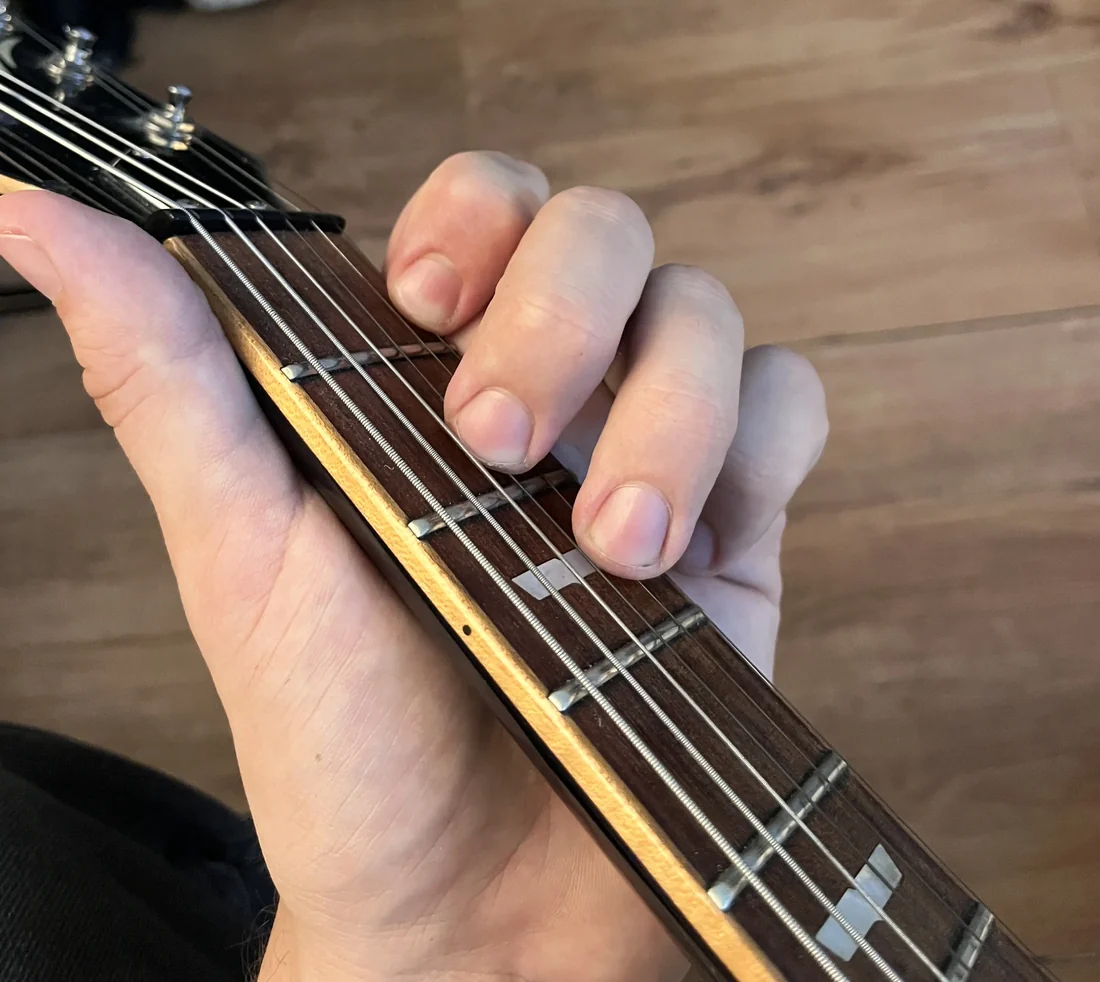
Dm chord diagram
e|---1---
B|---3---
G|---2---
D|---0---
A|---x---
E|---x---
x means do not play that string. 0 means play the open string.
How to practice Dm
Build the shape slowly
Place one finger at a time, then strum once and listen for muted strings.
Release and return
Take the hand off, shake out tension, then rebuild the chord without squeezing harder.
Use it in music
Move from the chord into one simple song loop so the shape has a purpose.
Fix and practise this chord
Common questions
Is Dm a beginner guitar chord?
Dm is medium for most beginners. Practice it slowly and use songs that give your hand time to change.
What songs use Dm?
Dm appears in many beginner arrangements and chord progressions.